
by John Wijngaards, published in UCANews, 21 October 2024, see below
The new Cardinal, Timothy Radcliffe OP, wrote in the Osservatore Romano (16 Oct): “I see the Spirit working in the Synod in his leading us into the fullness of truth”. Great! He is right! But will the Synod face up to the truth that women’s sacramental ordination to the diaconate needs to be urgently restored? Indeed, for a millennium, tens of thousands of women were ordained deacons. And this ordination was indisputably fully sacramental.
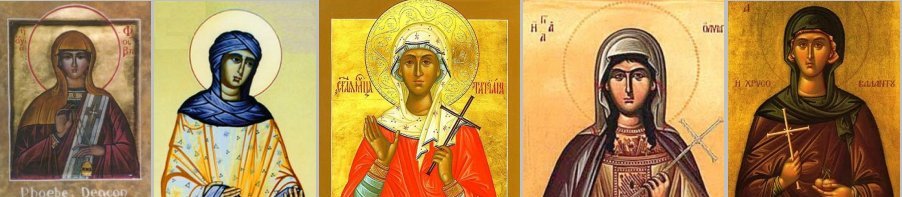
How do we know these women ministered as deacons in their local communities? The evidence is truly overwhelming.
In Paul’s letters we read about “Phoebe, our sister, who is a deacon [diakonos] of the church at Cenchreae” (Rom 16,1-2). Notice that in the original Greek the male title diakonos is applied to her. We also find this instruction in a paragraph addressed to deacons: “Deacons [diakonous] must be serious, reliable in what they say, not given to wine, not greedy for money […]. The women [= women deacons] in the same way should be respectable, not gossips, but sober and reliable in everything” (1 Tim 3,8-11).
The ministry of women deacons is mentioned by the Fathers of the Church: St Clement of Alexandria (150-215), Origen (185-255), Epiphanius of Salamis (315-403), St Basil of Caesaria (329-379), St John Chrysostom (344-407), St Gregory of Nyssa (335-394) and many others.
Just like male deacons, women deacons are extensively covered in early Pastoral Manuals, such as the Didascalia of the Apostles (ca 250 AD) and the Apostolic Constitutions (ca 380 AD). The latter contains early ordination rites for bishops, priests and deacons, including for women deacons. Church legislations, such as under Emperor Theodosius (390 AD) and Emperor Justinian I (529-564), give women deacons the same rights and duties as other members of the clergy, apart from some specific provisions.
Moreover, we have ample historical records of the ministry of women deacons in Greece, Asia Minor, Dalmatia, Syria and Palestine, from certainly the third to at least the eighth century. St Chrysostom at Constantinople had 40 women deacons attached to the basilica of Hagia Sophia, as well as 100 male deacons. From the correspondence of church writers and inscriptions on tombs we know 135 women deacons by name.
But how were they ordained? Do we know what the ordination rite for women deacons looked like? Yes, we do.
Their ordination rite was substantially identical to the rite used for male deacons. The rite has been preserved in ancient manuscripts, such as the Barberini Gr 336 (780 AD), the Bessarion (1020 AD), Vatican Mss Gr 1872 (1100 AD), the Coislin Gr 213 (1050 AD) and the Codex Vaticanus Syr 19.
These documents show that:
- Before the ordination of both the male and female deacon the bishop publicly declared his intention of ordaining the candidate to be a deacon through the ‘Divine Grace’ statement, as only happened for all major orders. “Divine Grace has chosen so-and-so to be a deacon for this-or-that community.”
- The female deacon, just like her male counterpart, was ordained by the bishop imposing hands on her while invoking the Holy Spirit: “Holy and Omnipotent Lord, through the birth of your Only Son our God from a Virgin according to the flesh, you have sanctified the female sex. You grant not only to men, but also to women the grace and coming of the Holy Spirit. Please, Lord, look on this your maidservant and dedicate her to the task of your diaconate, and pour out into her the rich and abundant giving of your Holy Spirit.”
- After some intercessions, the bishop, again imposing hands, spoke a second prayer of ordination, the ekphonese, characteristic only for the three major orders of episcopacy, presbyterate and diaconate.
- The ordination of both male and female deacon took place in the sanctuary before the altar, during the liturgy of the Eucharist and at a very solemn moment, namely after the sacred Anaphora, just like for the ordination of male deacons, presbyters, and bishops. In contrast, so-called minor orders, such as the lectorate and subdiaconate, were imparted by a simple imposition of hands outside the sanctuary and not during the Eucharist.
- Both the male and the female deacons received the diaconal stole, the diakonikon, as a sign of their ecclesiastical rank.
- During the ordination rite the bishop handed the chalice to the female deacon, just as he did for the male deacon, which indicates that deacons of both sexes had equal authority to distribute communion.
To confirm the validity of their ordination, overwhelming evidence shows that, at least in the Eastern part of the Church, women were fully accepted as ordained ministers during the first millennium.
The First Council of Nicea (325 AD), while declaring invalid the diaconate of women in the sect of Paul of Samosata “because those women had not received the imposition of hands”, implicitly acknowledged women’s diaconate as a valid order in the Church. The Council of Chalcedon (451 AD) imposed a minimum age on female deacons, as it did on male deacons and priests, an injunction repeated by the Council of Trullo (692 AD).
Many Popes endorsed women’s diaconate. Representatives of Pope Sylvester I (314-335) attended the Council of Nicea which accepted women deacons. Pope Innocent I (401-417) corresponded with John Chrysostom, the archbishop of Constantinople, who regularly ordained women deacons. The Council of Chalcedon, which imposed an age limit on women deacons, was partly organised by Pope Leo the Great (440-461). Pope Gregory I (440-461) composed a sacramentary which contained the ordination prayer for a woman deacon, identical to the prayer for a male deacon. At the request of Emperor Charlemagne, Pope Adrian I (772-795) sent a model sacramentary with ordination rites, the Hadrianum, to Gaul. It contained the ordination prayer for women deacons.
Restoring women’s diaconate is an urgent pastoral need for our time.
Though the ordination of women deacons remained known in the West till the Middle Ages, it met heavy resistance in many regions which had been part of the Roman empire. This was due to a bias against menstruation by which it was feared female ministers could pollute the altar and the Roman belief that women are inferior to men. In the East the ordination of women deacons ceased after 1000 AD by a combination of the fact that the number of adult catechumens diminished and by the same fear of menstruation.
Society in our time is rising above such ancient prejudices. Women are now proving their value in education, medicine, science, commerce, government and other spheres of modern life. Women too have been playing a crucial role in the life of the Catholic Church which often amounts to a real diaconal ministry. It is only right that they should be supported and affirmed in this by receiving a true ordination, as their male counterparts do.
The facts enumerated in this article are fully documented on our Wijngaards Institute websites: www.womendeacons.org and www.womenpriests.org.
Let us recall the teaching of the Early Church: “So, bishop, appoint for yourself fellow-ministers in almsgiving, assistants who may co-operate with you towards life. You are to choose and appoint deacons from all the people who are pleasing to you, a man for the administration of the many things which are necessary, a woman however for the ministry of women, since there are houses where you cannot send a deacon to the women because of the pagans but you can send a deaconess, and in many other matters there is need for an office of deaconess . . . The male deacon is present as a representation of Christ, and is therefore to be loved by you. And the deaconess is to be honoured by you as a representation of the Holy Spirit” (Didascalia, 250 AD, 9 § 3;16 § 1).
John Wijngaards